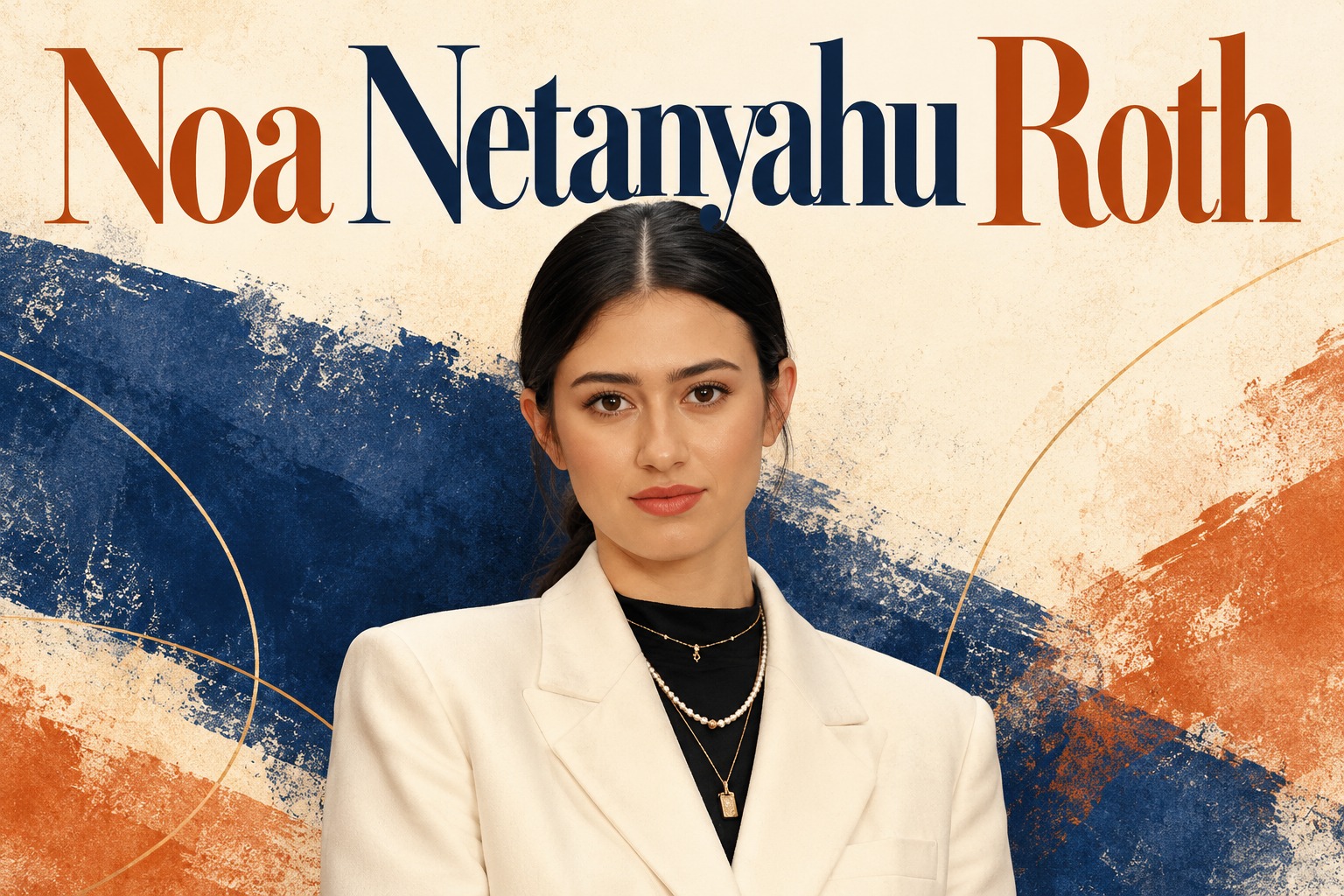
A daughter with a different public presence
Noa Netanyahu Roth was born in Jerusalem in 1978, the only child of Benjamin Netanyahu and his first wife, Miriam Haran. Her family name is familiar internationally, yet her own public presence is comparatively limited. I find her biography most clearly expressed through its actual relationships and religious context, rather than through the assumption that a prominent parent’s daughter must also be a political personality.
She is Benjamin’s eldest child. That fact places her earlier in the family chronology than his sons Yair and Avner, who were born during his later marriage to Sara Netanyahu. The distinction is straightforward but important: Noa and the two sons share a father, while their mothers and early family histories differ.
Miriam Haran and the first marriage
Noa’s mother, Miriam Haran, was previously known as Miriam Weizmann. She is an environmental scientist with a chemistry doctorate and a career associated with environmental administration and public service. Her work included leadership in Israel’s Ministry of the Environment and responsibilities related to environmental issues.
Benjamin and Miriam separated shortly after Noa’s birth. Noa was raised primarily by her mother, making Miriam a central figure in her early family life. I think this maternal connection deserves more attention than it receives in profiles organized entirely around Benjamin’s political career.
Miriam’s scientific and administrative background supplies a second professional strand to the family story. Noa’s parents came to public attention through different fields, one political and one scientific. Their daughter’s biography should not lose the latter simply because the former attracted a larger audience.
Benjamin Netanyahu and the paternal connection
Benjamin Netanyahu was born in 1949 and built a career in diplomacy and Israeli politics, including repeated service as prime minister. That longstanding public career explains the attention directed toward his children and wider family. It also explains why even a comparatively quiet family member may be mentioned in discussions of national political life.
I keep the relationship precise. Benjamin is Noa’s father, but his political positions, legal disputes, and public decisions are his own. The existence of a daughter does not establish that she participates in those activities or shares every opinion associated with him.
Her place in the family also includes motherhood. Through Noa’s children, Benjamin became a grandfather. That personal relationship belongs to the family chronology rather than the record of governmental office, even when public interest in the grandfather brings it into view.
Daniel Roth and religious family life
Noa married Daniel Roth, who has been identified as an ultra-Orthodox professional working in the technology sector. Noa herself adopted an ultra-Orthodox, or Haredi, Jewish way of life. The couple have children, and family coverage has described their connection to an ultra-Orthodox community in Jerusalem.
Her family moved to Mea Shearim in 2015. That neighborhood association provides a setting for her religious life. Daniel’s technology work also illustrates that a religious identity and a modern professional occupation can exist within the same family.
I avoid making a religious commitment into a complete account of someone’s personality. Haredi observance describes an important dimension of Noa’s adult life. It does not establish her private motivations, the precise course of her education, or the daily division of responsibilities within her marriage.
Yair and Avner as half brothers
Yair Netanyahu was born on July 26, 1991, and Avner Netanyahu on October 10, 1994. They are Benjamin and Sara Netanyahu’s sons and Noa’s paternal half brothers. The age differences separate Noa’s childhood from theirs by more than a decade.
Yair has been associated with a highly visible social media presence and public commentary. Avner has generally maintained a less prominent profile and has been connected with military service and further study. Their different levels of visibility help show why a shared family name does not produce a uniform public life.
My focus remains on kinship rather than on turning every headline about either brother into an episode in Noa’s biography. A sibling’s public controversy or relationship development concerns that sibling. It may explain renewed interest in the family, but it does not reveal what Noa was doing or thinking at the time.
The older Netanyahu generations
Noa’s paternal grandfather was Benzion Netanyahu, a historian who lived from 1910 to 2012. Her paternal grandmother, Tzila Netanyahu, lived from 1913 to 2000. Their lives connect Noa with an earlier generation of the family, beyond her father’s political career.
The next generation back includes Nathan Mileikowsky, a rabbi and Zionist speaker, and Sarah Mileikowsky. The Mileikowsky and Netanyahu names therefore belong to the same wider lineage. I find that naming history useful because it explains why an account of the family may contain both surnames without describing unrelated households.
These older relatives also broaden the professional and cultural context. History, religious speaking, science, politics, and technology all appear across the family network. Noa’s own religious commitments sit within that varied background rather than providing a simple continuation of a single family profession.
A biography built around actual relationships
Noa’s public portrait is primarily one of family and religious affiliation. Her parents, husband, children, half brothers, and grandparents already provide an identifiable structure.
The quieter scale of her public life is itself compatible with a meaningful biography. The central facts describe a woman born into a politically recognizable family who established an adult household associated with Haredi Jewish life, while her parents and siblings pursued distinct public paths.
FAQ
Who are Noa Netanyahu Roth’s parents?
Her parents are Benjamin Netanyahu and Miriam Haran, formerly Miriam Weizmann. Noa was born in Jerusalem in 1978 and is their only child together. Her parents separated soon afterward, and she was raised primarily by her mother.
Is Sara Netanyahu her mother?
No. Sara is the mother of Noa’s paternal half brothers, Yair and Avner. Noa’s mother is Miriam Haran. Keeping the marriages and generations separate is essential to understanding the family’s structure.
Who is Noa’s husband?
She is married to Daniel Roth, an ultra-Orthodox technology professional. They have children and have been associated with Haredi community life in Jerusalem. Their household belongs to Noa’s own adult biography rather than her father’s political career.